Monday, May 25, 2009

I can has scienz


(Well, it seemed funny when the idea came to me. I haven't seen this anywhere, but no doubt it will have occurred to others also.)

Creationism - a party of no Idas?

The media hype about Ida is wearing thin.

But by contrast Dana's post is a delightfully clear summary of the issues. Perhaps the most engaging one I have read.

Sharpening the horns

I recently saw a version of the Euthyphro dilemma that to me resonates better than the usual presentation. It's the same argument, but it fits better as a reply when theists do the old "can't be moral without God" dance.

In a comment by Ian Spedding at John Wilkins blog, he said:
"Ask them if they believe their chosen deity is a capricious being or one of reason and order. If the former, why follow a moral code that was thought up on a whim, if the latter, what is to prevent us from reasoning to the same conclusions all by ourselves."

I have a feeling it may be further teased along, but it's a good one as is.

(Some of the other discussion in that comment thread is also interesting.)

[edit: b0rken link fixx0red]

Friday, May 8, 2009

creation and existence

If you assert that everything that exists must have a creator, then you assert that either god does not exist or god in turn had a creator.

If you instead agree that at least some things don't have a creator, then there is no need to posit a creator at all.

Infinite cake.

I can happily have ice-cream without whining that I can't enjoy it because nobody promised I would get infinite cake after I finish.

The lack of infinite cake does not make the ice-cream worthless. Instead, undistracted by the imaginary need to gather cake-forks, I can focus on the very real ice-cream at hand, and enjoy it while it lasts. It's pretty good ice-cream.


Friday, May 1, 2009

Why 60 Dem senators is not all that filibuster-proof

There's a lot of noise about Arlen Spector's move to the Dems, which along with Al Franken (when he finally gets there, probably some time in 2011) makes for 60 democratic Senators.

But 60 democratic senators, while it sounds filibuster-proof, is nothing of the kind.

If the democrats try to rely on those 60 votes, where does the power lay? With the right-leaning democrats. It hands blue dogs the ability to bring on a Republican filibuster any time they have an issue that they want their own way on... and I don't imagine they won't use it a few times.

They can't do it *every* time, but that doesn't mean that they can't do it at all. If there's something they *really* want, you can bet that's a bargaining chip they know they hold. Even if they don't actually use it, the threat may be enough to get them what they want at the bargaining table.

Let's wait and see how it all pans out.

Monday, April 20, 2009

No posts in a month!

I don't think I've gone a month without posting before on this blog.

This has been caused by a number of things - an ongoing illness, combined with work pressure has led to a general ennui with regards to writing much. Anyway, I won't bore you about it, but I wanted to say that I am still around.

I have a number of topics to talk about, but finding the energy to actually turn them into priceless prose? Not so much. Hopefully I will be back at it in all senses very soon.

Wednesday, March 11, 2009

An ambigram

Hemant mentioned that he wanted a "flying spaghetti monster" ambigram tattoo.

That struck me as a pretty tricky thing to do, so I had a go at just making "Spaghetti Monster" just to see if it was possible. It's a quick and dirty attempt with no artistic merit, but I think it's adequate as a proof-of-concept that an ambigram something like what he wants should be quite doable in the hands of a more accomplished artist with the time to attempt it.


The Atheist "A" was just something I tossed in at the last moment (I noticed it on my blog as I was about to upload a first attempt and wondered if I could work it in. The answer was "yeah, sort of").

Saturday, March 7, 2009

Will Lie for $$$

The people providing political commentary on US TV are extraordinarily wealthy. As far as I can tell, they're all in the top tax bracket.

As a result, their opinions are necessarily coloured by that fact. Even the honest ones (a list which appears to be quite short) will give you the news filtered through the lens of its impact on them. So you cannot easily get much useful information about its impact on you. And many of them (I'm looking especially at some people on Fox News and CNBC) will lie right to camera if they think it will make them better off.

Their alarmism makes people make bad decisions. Instead of debunking the bad decisions they've caused, these parasites will encourage them. The lesson is threefold:
  • You can't trust main-stream media. At all. Ever.(1)

  • You have to work things out for yourself. (2)

  • You can't trust main-stream media. At all. Ever.

  1. Watch them by all means, but always assume that every word comes with an agenda, and make sure you understand how the person you're watching (and the people they work for) are lining their own pockets. Follow, as the saying goes, the money. They will tell you what's good for them, not what's good for you. They will tell you what's bad for them, not what's bad for you. They will exploit you.

  2. That's a nuisance. There are plenty of sources of good information online, but there are plenty of bad sources of information, too. You have to equip yourself at least well enough to tell a good argument from a bad one, and read more than one source of information.

There's a major case in point on income tax. And it's not just the cable news and finance guys that you have to watch out for - networks and the newspapers are doing it too.

They're exploiting dumb people. They want you to be dumb too.

Specifically, one thing that's got me cranky is the way the media has been playing up stories about people trying to earn less than $250,000 in order to pay less tax (as discussed in several of the links). Instead of doing the responsible thing - explain the actual situation - they're encouraging you to misunderstand.

Most of my readers are very smart, so I'm probably stating the obvious, but let's look at what's going on.

Most western countries have a progressive tax system. That means that as you earn more, you pay a higher percentage of your income in tax (however, as you earn more, your ability to shift income in ways that lowers your tax rate also goes up, so it's sometimes not progressive at all).

This happens by there being progressively higher tax rates on the amount you earn above particular threshholds, creating what are called "tax brackets"

In the US in 2008, the top marginal tax rate (the amount you pay on your last dollar) was 35%. But the average tax rate for everybody is below that. What's happening is that the two highest marginal tax rates for those with the highest incomes in the US will in 2010 go ... back to what the highest two marginal rates were in 2000. That's all.

The very, very highest incomes will - in 2010 - be paying 39.6% on their last dollar.

The total (or average) tax rates for 2008 look like this (public domain image by Dejo):


What's happening is that in 2010, the green line will move up a bit, but in fact most people in the US will actually pay a little less tax - the red and black lines will only be higher up the right hand end - and most people are quite a way left of the middle of the graph).

Guess what? I already pay more than 39.6%. My marginal tax rate here in Australia is 40% (and it's recently gone down - I was paying 42%). If I was earning my current income in the US, I'd be paying 25%, not 40%. I pay a higher marginal rate of tax than every Rick Santelli in the US. Actually, if you include the way some of the government benefits reduce with income (something I strongly support), my effective marginal tax rate (impact of the last dollar I earn) is actually a fair bit higher than 40%.

The top marginal income tax rate here is 45% - oh, and there's also a consumption tax.

I experience very little disincentive to earn an extra dollar of income, even though I am paying a higher marginal rate of tax than everybody in the US will be paying, even after the tax changes come in. (The biggest disincentive I experience is simply the marginal cost in time, a far more scarce resource to me than money.)

I don't feel like I pay "too much" tax. I drive on roads. My kids go to school. I get less expensive prescription drugs than I otherwise would. When I have to go to the doctor, I get most of the money back. There are police, fire brigade, ambulance services and a hundred other things that make it possible for me to earn that money I pay tax on, and make it possible for me to enjoy the benefits of the rest of it.

I also gain the security of knowing there are a couple of safety nets available if everything were to go pear-shaped. The fact that other people are getting the benefit of those safety nets right now is not a source of envy - if you're badly enough off that you need them, there's really not much to be envious of.

Here's something to keep in mind: if they'll lie to you about that, what else can't you trust them on?

Monday, March 2, 2009

It's times like this I wish...

... that I had more than high school physics.

I was solving a nifty little optimization problem which occurred to me as a continuous version of a discrete problem that used to come up in an old computer game I used to play long ago. The problem boiled down to finding a best route of travel given two different speeds in different kinds of terrain.

Anyway, after a page of scribbling around, I came up with a formula for a simple case of the problem.

Then I realized that my simple case was (in a modified form) essentially going to be solved by Snell's Law (also called the Law of Sines). And sure enough, my simple formula was Snell's law (but changed about a bit so it wasn't instantly obvious, like having a ratio of cosecants of angles to the normal instead of sines - which is just a matter of inverting both sides...).

This is essentially what I was doing, but less formally and with a lot more faffing about and a few false starts. (It's easy to find on-line if you already know what to look for, eh?)

I felt like a bit of a dope. On the other hand, at least I was definitely on the right track. Since I'd had a headache all day, that was all I could manage in the time available, so I didn't go on to derive the problem I was actually interested in (the shape made by traveling as far as you could in a given time, given a particular boundary between the two regions), but with Snell's Law it should become a somewhat more straightforward calculation for the situations I was playing with (since it tells me "where to head" after striking a smooth boundary, so for the simpler cases it's a matter of computing where you end up given each boundary point).

Saturday, February 28, 2009

The bus...

After going to the trouble of making my own "atheist bus" headlines (I have several ready to go if I decide they're worthwhile), I find out there's a website already set up that puts it on the bus for you and everything.

Friday, February 27, 2009

There's probably no...

There's probably no teapot. Now stop worrying and drink your damn tea.

Ding-dong, the witch is (probably) dead.

Looks like the Aus. government's compulsory web-censorship plans are dead.

Nick Xenophon changed his mind (even though he was doing it because he figured it would help his anti-gambling stance), so they don't have the senate numbers any more.

I'm leaving the banner up for now though, because Conroy has had his tits all over this like a stripper looking for a 20, and if it can be revived, you can bet he'll do it - I expect this legislation to be a zombie and rise again, looking for brains.
(Stephen Conroy is the Minister for Broadband, Communications and the Digital Economy... and rubbing his tits all over brain-eating zombies)


What's the point in metaphors if you can't mix them? Or stick 'em in a blender on "pulverise"?

Saturday, February 21, 2009

Technology stuff

Hey, did you know the Chinese have a cell-phone battery that can last a lifetime?

(line break in link now fixed)

Thursday, February 19, 2009

The law of recursion

An observation based on reading many comment threads:

As any comment thread grows sufficiently long, the probability that Godwin's law will be mentioned approaches 1.

Wednesday, February 11, 2009

Reading the man

I'm reading Darwin's Origin of the Species.

I've read extracts before, and one day I sat in a library and read a chunk of it, but I've never actually read the book before.

I'm not doing anything high-minded like reading it for the blog for Darwin campaign or anything - it just happens to be one of the many books I bought when I was in Washington D.C. last year, and I've read the other science books (Shubin's Your Inner Fish, Sagan's The Varieties of Scientific Experience, both recommended). I just wanted to read it, and there was a reasonably-priced edition.

I feel the same sense of excitement I had when I plunged into D'Arcy Thompson's On Growth and Form, a book which can unfortunately only be experienced for the first time once. (If you've never read it, do yourself a favour and try to find a copy. Mine was the shorter 328 page edition.), except that with Origin, instead of a well-regarded descriptive book on the fringes of mainstream biology, we have a book critical to modern biological thought.

Friday, February 6, 2009

Oh, brave new world ...

... that has glider guns in't!

This is freaking cool. But if Belousov-Zhabotinsky reactions or cellular automata are unfamiliar, don't go there just yet, read this first.

Wow, I want to explain six different things at once. Where to start.


There's some amazing chemicals (quite a few different ones) that undergo Belousov-Zhabotinsky reactions, which switch between states. The image shows one such reaction where there's a cyclical colour change.


If you set up a BZ reaction in a thin layer (say something like a petri dish), then you can observe beautiful cycles of spiral waves.

Very similar spiral waves of excitation are observed, for example, in certain cardiac problems.


Now, to go off in a completely different direction, there are mathematical constructs called cellular automata (CAs).


These are basically a layout of cells - often in a line, or sometimes in a 2-D array (or sometimes even in higher dimensions), which evolve according to simple local rules (such as "if the cells either side of me are both black, next step I will change to white"). The image here is of the development of one such CA, called "Rule 30". As you progress down from the top, each row of the image represents one "time step" in the development of this 1-d cellular automaton.

While they were originally purely mathematical ideas, patterns that arise in essentially the same way, and look very much like those seen in some kinds of cellular automaton do occur in nature, for example, on some kinds of shells:


Further, people have noted in the past that a particular kind of cellular automaton, the cyclic cellular automaton can generate very distinctive spiral waves that look somewhat like BZ spiral waves.

The most famous of these cellular automata is undoubtedly Conway's game of Life, a 2D one that produces some amazingly intricate patterns.

One very early pattern that was discovered is called a glider - a pattern only a few cells across that changes in such a way that it appears to "fly" diagonally in a straight line.
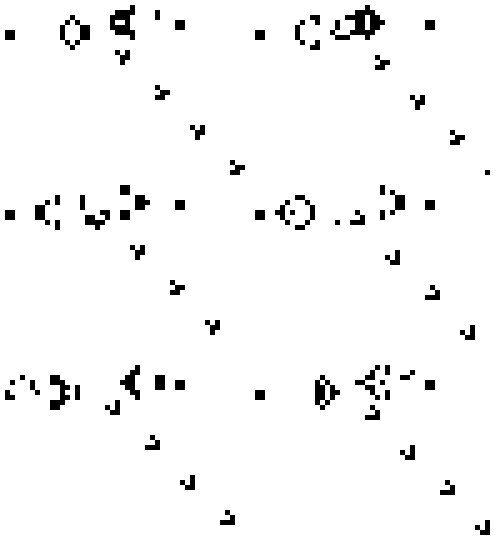


In 1970, Bill Gosper, in response to a challenge by Conway to find a Life pattern that would show "unlimited growth", designed a constuction that produces a constant stream of gliders, called a "glider gun". (There are a large number of other constructions that exhibit such unlimited growth.)


Using many structures such as this, it has been shown that it is possible to construct a kind of computer that is equivalent to a Turing machine.

In 2005, Motoike and Adamatzky discussed using Belousov-Zhabotinsky reactions in the construction of logic gates in liquids, and there has been a bunch of other related papers.

Now to the new bit. There's a new paper up on arXiv where a bunch of researchers the University of West of England (including Adamatzky) have constructed, using BZ reactions, a chemical version of a glider gun (it's not exactly a game-of-life glider gun, but it has similar properties.


As the authors say in their conclusion, "theoretical ideas concerning universal computation in these systems is closer to being realized experimentally. We were able to manipulate glider streams, for example annihilate selected streams and switch periodically between two interacting streams. We were also able to show that glider guns could be formed or annihilated via specifi c interactions with glider streams from a second gun. We also showed examples where glider guns could be used to implement simple memory analogs."

They also say, "[t]hese discoveries could provide the basis for future designs of collision-based reaction-diffusion computers". Indeed.


There may well be implications relevant to the development of the earliest self-reproducing structures (protolife) on earth.

via The physics arXiv blog

Thursday, February 5, 2009

What distinguishes the best arguments for god from those of the ordinary believer?

Atheists are often derided for arguing against the dumb arguments for God that we encounter every day. (Well, it makes sense - those are what we're hit in the face with. Those are the ones in the media, in things like school board meetings, in everyday conversations, and the ones that show up in our blog-comments.)

But many of us get slammed for not engaging with the arguments of the sophisticated theists. I've seen a couple of supposedly sophisticated arguments before, and not been impressed.

Now, Greta Christina takes on the best arguments for God.

(Well, they're framed as "questions for atheists", but they're basically a list of "but what about this?" arguments for God.)

And one thing really stands out. I can see the difference now.

What distinguishes the best arguments for god from those of the ordinary believer?

They're not in ALL-CAPS, 14-point purple Comic Sans, they're correctly spelled, and they show a passing acquaintance of grammar... apart from that, well... they're pretty much just slightly more polished versions of exactly the same arguments we see all the time.

That's it.

That's all they got.

I am sad.

Dissing the doctor

PZ discusses a reporter at the L.A. Times dissing Jill Biden over her doctorate.

The really really stupid thing about this is you don't need to do more than the most basic research available to any moron with a good dictionary on the shelf or a keyboard - if you type "doctor" into wikipedia, it clears things up very nicely.

In short - the word "doctor" comes from the Greek "Didaktor Philosophias"* -- "teacher of philosophy", via Latin. Since the earliest degrees were law degrees, and the first law degrees were doctorates, the first such "doctors" were all doctors of
law - licensed to teach law. As the word "doctor" became more heavily used to refer to medical personnel, lawyers were known as "civil doctors".

*(transliterated into Roman characters here, since many people reading this don't read ancient Greek - though mathematical types can generally sound it out; I presume few actual ancient historians or people of classical education are readers of this blog)

The use of the word "doctor" to refer to someone of great learning in a particular academic sphere predates the use of it to refer to medical doctors.

Anyway, I have some thoughts on this. I have a PhD myself, and like most such, I'm not a stickler for titles.

Within any academic institution, I ask people to call me by my first name. However, if someone insists (against my wishes) on calling me by a title, then I will ask that if they must do so, they at least give the correct one.

(For some reason, at that point most of them knock it off and just use my name. Why not when I asked? Don't ask me.)

One reason I ask to be called by my first name is that I think when you're discussing ideas, they need to be disrespected. Beautiful and precious darlings though they may be, ideas that don't stand up to the harshest scrutiny need to be taken down to the idea vet, and given radical, lifesaving surgery, or for the ones beyond such help, unceremoniously put out of their misery.

Now if people are too busy bowing (and yes, that's actually happened) and respecting the person, they can't at the same time kick the crap out of their ideas. When that happens, there is no hope for them (the people or the ideas).

So first names, like we're colleagues trying to figure this stuff out. Paradoxically, I see it as a sign of respect, but it's a very particular kind of respect.

Outside of academia, my own attitude is one of laissez-faire - generally, my PhD is completely irrelevant. Most people neither know nor particularly care what a PhD is, and I don't tend to bring it up unless it's directly relevant to the conversation, someone specifically asks, or is being a major dick about it in some way.

Well, my employer puts it on my business cards; I don't begrudge them that, since they say it makes them look good.

There is exactly one person who universally refers to me by the title "Doctor". Perhaps ironically, given the current discussion, it's my GP. (He puts it on every prescription, on every referral, and calls me "doctor" to my face. And when he does it, he makes it mean something. It's very touching.)

So, given I don't really use it myself, it might seem weird to care about the use of academic titles.

But on the other hand, it annoys me to see people disrespect the honorific. A PhD is generally a signal that someone has done a great deal of very hard work, sometimes at a significant cost to themselves, their families and maybe even their health. It's also generally a sign that that someone knows a lot about their particular subtopic.

That entitles them to be called "doctor" in formal writing, whether or not a reporter with an inferiority complex likes it or not. Further, if the possessor of such a title wants their title used at other times, then dammit, they have that right, too. If you don't like it, go and damn well get one, and then you can tell people not to call you doctor.

Good luck with that. We could use more people who give a damn about learning, especially among reporters.